HKDSE 2026 Maths Paper II 題解
HKDSE 2026 Maths Paper II Answers and Solutions
香港中學文憑考試 2026 數學卷二答案+題解。
&\frac{1}{k +2} +\frac{3}{5k -6}\\[2pt] =&\frac{(5k -6)+3(k +2)}{(k +2)(5k -6)}\\[2pt] =&\frac{5k -6 +3k +6}{(k +2)(5k -6)}\\[2pt] =&\frac{8k}{(k +2)(5k -6)}
\end{align*}$$
&\ \frac{9^{3n+1}}{(3^{2n +3})(27^{2n+1})}\\[2pt] =&\ \frac{\big(3^2\big)^{3n+1}}{\big(3^{2n +3}\big)\big(3^3\big)^{2n+1}}\\[2pt] =&\ \frac{3^{6n+2}}{(3^{2n +3})(3^{6n+3})}\\[2pt] =&\ \frac{3^{6n+2}}{3^{8n +6}}\\[2pt] =&\ 3^{-2n -4}\\[2pt] =&\ \big(3^2\big)^{-n-2}\\[2pt] =&\ 9^{-n-2}
\end{align*}$$
&\ (2\alpha -\beta)^2+(\alpha -2\beta)^2\\
=&\ 4\alpha^2 -4\alpha\beta +\beta^2 +\alpha^2 -4\alpha\beta +4\beta^2\\
=&\ 5\alpha^2 -8\alpha\beta +5\beta^2
\end{align*}$$
$$\color{red}{230.0}45678 \approx 230.0$$
當準確至四位小數 (4 decimal places)
$$230.\color{red}{0456}78 \approx 230.0457$$
因此答案是 A。
$$\begin{align*}
(x -5)(x +m) -4(x +n) &= x(x +6) +1\\
x^2 +mx -5x -5m -4x -4n &= x^2 +6x +1\\
mx -9x -5m -4n &= 6x +1
\end{align*}$$
比較係數 Comparing the coefficients,
$$\begin{cases}
m -9 = 6\ …(1)\\
-5m -4n = 1\ …(2)
\end{cases}$$
由 (1),##m = 15##
把 ##m = 15## 代入 (2),
$$\begin{align*}
-5(15) -4n &= 1\\
-4n &= 76\\
n &= -19
\end{align*}$$
方法二:
對於恆等式,x 是任何數值,該等式均成立。
For an identity, the equality is always true regardless of values of x.
代入 ##x = 5##,
$$\begin{align*}
(5 -5)(5 +m) -4(5 +n) &= 5(5+6) +1\\
-4 (5 +n) &= 56\\
5 +n &= -14\\
n &= -19
\end{align*}$$
$$\begin{align*}
(x +2s)(x +t)&=sx +st\\
(x +2s)(x +t)&=s(x +t)\\
(x +2s)\color{red}{(x +t)} -s\color{red}{(x +t)} &= 0\\
(x +t)(x +2s -s) &= 0\\
(x +t)(x +s) &= 0\\
x = -t \text{ or } x&=-s
\end{align*}$$
方法二:
把各選項中的解代入方程,如果左方和右方相等,該解為正確。
當 x = −s,
$$\begin{align*}
\text{左方 LHS} &= (-s +2s)(-s +t)\\
&= s(-s +t)\\
&= -s^2 +st\\[6pt]
\text{右方 RHS} &= s(-s) +st\\
&= -s^2 +st\\
&=\text{左方 LHS}
\end{align*}$$
即是 x = −s 為方程的解,並可排除選項 B 及 D。
當 x = −t,
$$\begin{align*}
\text{左方 LHS} &= (-t +2s)(-t +t)\\
&= (-t +2s)(0)\\
&= 0\\[6pt]
\text{右方 RHS} &= s(-t) +st\\
&= -st +st\\
&= 0\\
&=\text{左方 LHS}
\end{align*}$$
即是 x = −t 為方程的解,並可確定答案為 C。
\ \\
\begin{align*}
f(1 +d) &= 0\\
(\color{red}{1 +d} +d)(\color{red}{1 +d} -2) +9(\color{red}{1 +d}) &=0\\
(1 +2d)(d -1) +9 +9d &= 0\\
d -1 +2d^2 -2d +9 + 9d &= 0\\
2d^2 +8d +8 &= 0\\
d^2 +4d +4 &=0\\
(d +2)^2 &= 0\\
d +2 &= 0\\
d &= -2
\end{align*}$$
g(x) is divisible by x − 4,
$$\begin{align*}
\therefore g(4) &= 0\\
h(4)^3 +2(4)^2 +k(4) -5 &= 0\\
64h +32 +4k -5 &= 0\\
64h +4k &= -27
\end{align*}$$ $$\begin{align*}
\text{餘式 remainder} &= g(-4)\\
&=h(-4)^3 +2(-4)^2 +k(-4) -5\\
&=-64h +32 -4k -5\\
&=-\color{red}{(64h+4k)} +27\\
&=-\color{red}{(-27)} +27\\
&= 27 +27\\
&= 54
\end{align*}$$
x -1 &\gt \frac{2x -9}{3} & \text{or}&\ & 3x +12 &\ge 0\\
3x -3 &\gt 2x -9 & \text{or}&\ & 3x &\ge -12\\
3x -2x &\gt 3 -9 & \text{or}&\ & x &\ge -4\\
x &\gt -6 & \text{or}&\ & x &\ge -4\\
\end{align*}\\
\ \\
\therefore x \gt -6$$
\frac{12s +18t}{s+t} &= 16\\[2pt] 12s +18t &= 16s +16t\\
18t -16t &= 16s -12s\\
2t &= 4s\\
2s &= t\\
\frac{s}{t} &= \frac{1}{2}
\end{align*}\\
\ \\
\therefore s:t=1:2$$
P \times \Big(1 +\frac{4\%}{4}\Big)^{5 \times 4} &= 80000\\
P \times (1.01)^{20} &= 80000\\
P &= 65563.6\\
P &\approx 65564
\end{align*}$$
=\frac{k\sqrt{1.44u}}{0.8v}\\
=\frac{1.2k\sqrt{u}}{0.8v}\\
=\frac{1.5k\sqrt{u}}{v}\\
=1.5z$$
百份數變化 Percentage Change
=&\ \frac{1.5z-z}{z}\times 100\%\\[2pt] =&\ \frac{0.5z}{z}\times 100\%\\[2pt] =&\ 50\%
\end{align*}$$
相關文章: 變分與百分數變化 Variation and Percentage Change
$$\begin{cases}
a_5 = 3a_4 -2a_3\\
a_4 = 3a_3 -2a_2
\end{cases}$$
代入 ##a_5 = 35, a_2 = 7##,
$$\begin{cases}
35 = 3a_4 -2a_3\\
a_4 = 3a_3 -2(7)
\end{cases}$$
整理後得到,
$$\begin{cases}
-2a_3 +3a_4 = 35\\
3a_3 -a_4 = 14
\end{cases}$$
Solving 解聯立方程,##a_4=19, a_3=11##
$$\begin{align*}
a_6 &= 3a_5 -2a_4\\
&= 3(35) -2(19)\\
&= 67\\[6pt]
a_7 &= 3a_6 -2a_5\\
&= 3(67) -2(35)\\
&= 131\\[6pt]
a_8 &= 3a_7 -2a_6\\
&= 3(131) -2(67)\\
&= 259
\end{align*}$$
x-intercept x截距 ##=\frac{b}{a}##
y-intercept y截距 ##=b##
slope 斜率 ##=-a##
從L1的 y 截距及斜率的正負,可判斷 ##a \gt 0, b \gt 0##
##L_2: cx +y = d##
x-intercept x截距 ##=\frac{d}{c}##
y-intercept y截距 ##=d##
slope 斜率 ##=-c##
從L2的 y 截距及斜率的正負,可判斷 ##c \gt 0, d \gt 0##
I) 比較它們的斜率,兩者階為負數,但 L1 比較下傾更多,亦即是斜率更負。
Comparing their slopes, both are negative. But L1 is steeper. i.e. Its slope is more negative.
$$\begin{align*}
L_1\text{斜率} &\lt L_2\text{斜率}\\
-a &\lt -c\\
a &\gt c
\end{align*}$$
∴選項 I 錯誤。
II) 比較它們的 y 截距,L1的 y 截距較大。
Comparing their y-intercepts, the y-intercept of L1 is greater.
$$b \gt d$$
∴選項 II 正確。
III) 它們的 x 截距相同。
Their x-intercepts are the same.
$$\begin{align*}
\frac{b}{a} &= \frac{d}{c}\\[2pt]
ad &= bc
\end{align*}$$
∴選項 III 正確。
##pq \lt 0##. It means p and q are non-zero. One is positive and the other one is negative.
I)
y &= (px +1)(qx +2)\\
y &= pqx^2 +2px +qx +2
\end{align*}$$
##x^2## 的係數是 ##pq##,而 ##pq\lt 0##,所以圖像開口向下。
The coefficient of ##x^2## is ##pq##. Since ##pq\lt 0##, the graph opens downwards.
∴選項 I 正確。
II)
方法一:
(px +1)(qx +2) &= 0\\
x = \frac{-1}{p}\text{ or } x&=\frac{-2}{q}
\end{align*}$$
兩個根同樣一個是正數,另一個是負數,因此無可能相同。
One root is positive and the other one is negative. So, they cannot be the same.
方法二:
$$\begin{align*}
\Delta &= (2p +q)^2 -4(pq)(2)\\
&= 4p^2 +4pq +q^2 -8pq\\
&= 4p^2 +q^2 -4pq \\
\end{align*}$$
當中每一項都是正數,因此 ##\Delta \gt 0##。
Every term is positive. So, ##\Delta \gt 0##.
∴選項 II 正確。
III)
y截距等於 2。
y-intercept is 2.
∴選項 III 錯誤。
\text{周界 Perimeter} &= 2\pi r\times\frac{\theta}{360\deg} +2r\\
k &= 2\pi (14)\times\frac{\theta}{360} + 2(14)\\
k &= \frac{7}{90}\pi \theta + 28\ …(1)\\
\ \\
\text{面積 Area} &= \pi r^2\times\frac{\theta}{360\deg}\\
3k &= \pi (14)^2\times\frac{\theta}{360}\\
3k &= \frac{49}{90}\pi\theta\ …(2)
\end{align*}$$
把(1)代入(2),
$$\begin{align*}
3k &= \frac{49}{90}\pi\theta\\[2pt]
3\big(\frac{7}{90}\pi \theta + 28\big) &= \frac{49}{90}\pi\theta\\[2pt]
\frac{7}{30}\pi \theta + 84 &= \frac{49}{90}\pi\theta\\[2pt]
\frac{49}{90}\pi\theta\ -\frac{7}{30}\pi \theta &= 84\\[2pt]
\frac{14}{45}\pi\theta &= 84\\
\pi\theta &= 270
\end{align*}$$ $$\begin{align*}
\text{弧長 Arc Length} &= 2\pi r\times\frac{\theta}{360\deg}\\[2pt]
&=2\pi (14)\times\frac{\theta}{360}\\[2pt]
&=\frac{7}{90}\times \pi \theta\\[2pt]
&=\frac{7}{90}\times 270\\[2pt]
&=21\text{ cm}
\end{align*}$$
\text{Volume of Pyramid 錐體體積} &= \frac{1}{3}\times 18 \times 16 \times 12\\
&= 1152
\end{align*}$$ $$\begin{align*}
\text{Y 體積} &= 1152 \times \Big(1-\big(\frac{12}{16}\big)^3\Big)\\
&= 666\text{ cm}^3
\end{align*}$$
方法二:
X\text{ 底長 length of base of }X &= 18 \times \frac{12}{16}\\
&=13.5\\
X\text{ 高 height of }X &= 12\times \frac{12}{16}\\
&=9\\[8pt] X\text{體積 Volume of }X &= \frac{1}{3}\times 13.5 \times 12 \times 9\\[2pt] &= 486
\end{align*}$$
$$\begin{align*}
Y\text{體積 Volume of }Y &= 1152 -486\\
&= 666\text{ cm}^3
\end{align*}$$
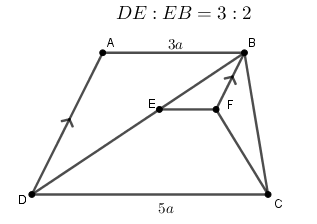
步驟 1) 求 EF
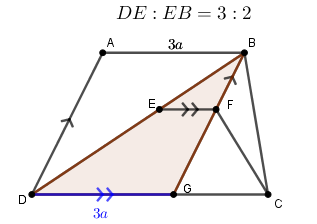
延長 BF 至 G 點,留意△BEF 及 △BDG
$$\begin{align*}
\frac{EF}{DG} &= \frac{BE}{BD}\\[2pt]
\frac{EF}{3a} &= \frac{2}{2+3}\\[2pt]
EF &=\frac{2}{5} \times 3a\\[2pt]
EF &= \frac{6a}{5}
\end{align*}$$
步驟 2) 參考下圖,求 ah 的值
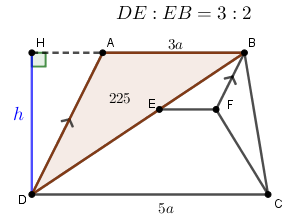
$$\begin{align*}
\frac{(3a)(h)}{2} &= 225\text{ cm}^2\\[2pt] ah &= \frac{225\times 2}{3}\\[2pt] ah &= 150
\end{align*}$$
步驟 3) 求 DI
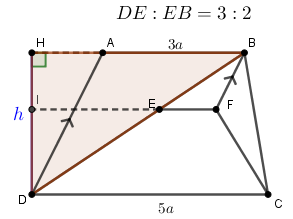
留意 △DBH及 △DEIH
$$\begin{align*}
\frac{DI}{DH} &= \frac{DE}{DB}\\[2pt]
\frac{DI}{h} &= \frac{3}{3+2}\\[2pt]
DI &= \frac{3h}{5}
\end{align*}$$
步驟 4) 求 CDEF 面積
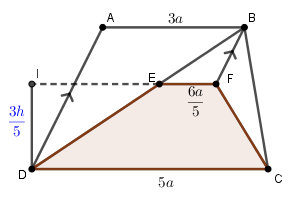
$$\begin{align*}
\text{面積} &= \frac{(\frac{6a}{5}+5a)\times \frac{3h}{5}}{2}\\[2pt]
&= \frac{\frac{31a}{5}\times \frac{3h}{5}}{2}\\[2pt]
&= \frac{93}{50}\times ah\\[2pt]
&=\frac{93}{50}\times 150\\[2pt]
&=279\text{ cm}^2
\end{align*}$$
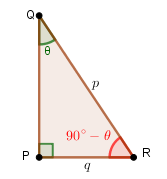
$$\begin{align*}
\text{面積 Area} &= \frac{1}{2}(QR)(PR)\sin\angle PRQ\\
S &= \frac{1}{2}(p)(q)\sin(90\deg -\theta)\\
S &= \frac{1}{2}pq\cos \theta
\end{align*}$$
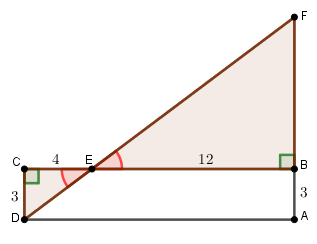
留意 △CDE∼△BFE,證明如下。
$$\begin{align*}
\angle DCE &= \angle FBE = 90\deg\\
\angle CED &= \angle BEF\ \text{(對頂角 Vert. Opp. }\angle\text{s)}
\end{align*}\\
\Delta CDE \sim \Delta BFE\text{ (AA)}$$
求 BF,
\frac{CD}{BF} &= \frac{CE}{BE}\\[2pt] \frac{3}{BF} &= \frac{4}{12}\\[2pt] 4BF &= 3\times 12\\
BF &= 9
\end{align*}$$
求 EF,
EF^2 &= BE^2 + BF^2\\
EF^2 &= 12^2 + 9^2\\
EF^2 &= 225\\
EF &= \sqrt{225}\\
EF &= 15\text{ cm}
\end{align*}$$
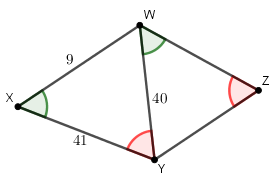
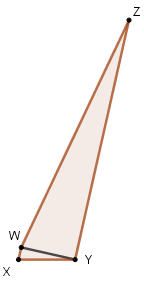
很明顯,△XYW∼△WZY,從而得到
$$\frac{XY}{WZ} = \frac{WY}{YZ} = \frac{WX}{WY}$$把已知的邊長代入。
$$\frac{41}{WZ} = \frac{40}{YZ} = \frac{9}{40}$$
\frac{41}{WZ} &= \frac{9}{40}\\[3pt] 41 \times 40 &= 9 \times WZ\\[2pt] WZ &= \frac{1640}{9}\\[8pt] \frac{40}{YZ} &= \frac{9}{40}\\[2pt] 40 \times 40 &= 9 \times YZ\\[2pt] YZ &= \frac{1600}{9}
\end{align*}$$
$$\begin{align*}
\text{周界 Perimeter} &= 9 +41 +\frac{1640}{9} +\frac{1600}{9}\\[2pt]
&= 410\text{ cm}
\end{align*}$$
注:如依比例繪畫,會得到以下圖像。
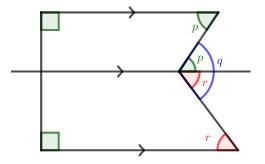
Refer to the figure, construct a parallel line.
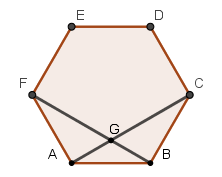
I)
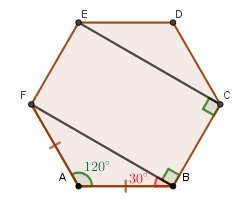
$$\begin{align*}
\color{green}{\angle BAF} &= \frac{(6 -2)\times 180\deg}{6}\\[2pt]
&=\frac{720\deg}{6}\\[2pt]
&=120\deg
\end{align*}$$ $$\because AF = AB\\
\begin{align*}
\therefore \color{red}{\angle ABF} &= \frac{180\deg – 120\deg}{2}\\
&= 30\deg
\end{align*}$$ $$\angle CBF = 120\deg -30\deg =90\deg$$
用同一方法,可找到 ##\angle DCE = 90\deg##
$$\begin{align*}
\angle CBF + \angle DCE &= 90\deg + 90\deg\\
&= 180\deg\\[6pt]
\end{align*}\\
\therefore BF\,//\,CE\text{ (int.}\angle\text{s supp. 同旁內角互補)}$$
∴選項 I 正確。
II)
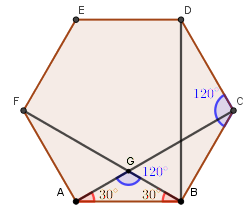
已知 ∠ABF=30°。從對稱性質, ∠BAC=30°
$$\begin{align*}
\therefore \angle AGB &= 180\deg -30\deg -30\deg\\
&= 120\deg
\end{align*}$$
在 △BDC,已知 ∠BCD=120°,加上 BC=CD。足以判斷 ##\Delta ABG \sim \Delta BDC##。
∴選項 II 正確。
III)
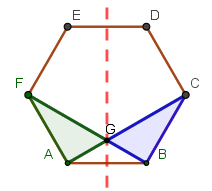
從對稱性質,很明顯 ##\Delta AGF \cong \Delta BGC##。證明如下
The figure is obviously symmetrical. So, ##\Delta AGF \cong \Delta BGC##. A detailed proof is shown below.
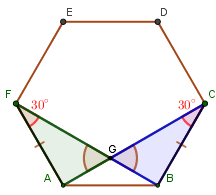
$$\begin{align*}
AF &= BC\\
\angle AGF &= \angle BGC\text{ (對頂角 Vert. Opp.}\angle\text{s)}
\end{align*}$$
用 (I) 所示的方法,得到
$$\angle AFG = \angle BCG = 30\deg\\[8pt]
\therefore \Delta AGF \cong \Delta BGC\text{ (AAS)}$$
##V=(1, 2)##
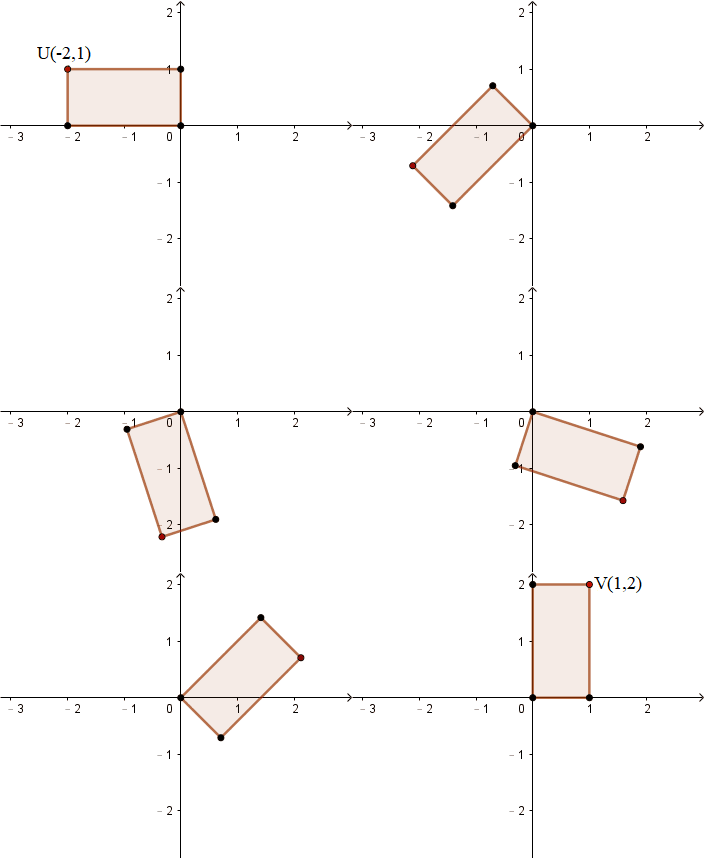
相關文章:文憑試實戰篇 #5 坐標旋轉 Rotation of Coordinates
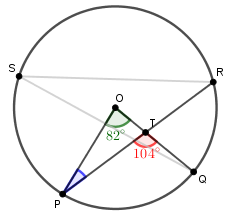
$$\begin{align*}
\color{blue}{\angle OPT} + \color{green}{\angle POT} &= \color{red}{\angle PTQ}\\
\angle OPT + 82\deg &= 104\deg\\
\angle OPT &= 104\deg -82\deg\\
\angle OPT &= 22\deg
\end{align*}$$
步驟 2) 求 ∠QPT
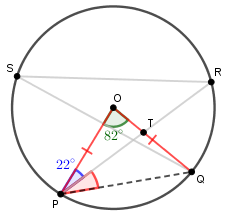
$$\because OP = OQ\\
\begin{align*}
\therefore \angle OPQ &= \frac{180\deg -82\deg}{2}\\[2pt]
\angle OPQ &= 49\deg\\[8pt]
\color{blue}{\angle OPT} +\color{red}{\angle QPT} &= \angle OPQ\\
22\deg +\angle QPT &= 49\deg\\
\angle QPT &= 49\deg -22\deg\\
\angle QPT &= 27\deg
\end{align*}$$
步驟 3) 求 ∠QSR
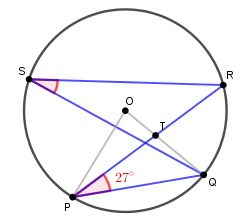
$$\begin{align*}
\angle QSR &= \angle QPT\text{ (同弓形內的圓周角 }\angle\text{s in the same segment)}\\
&= 27\deg
\end{align*}$$
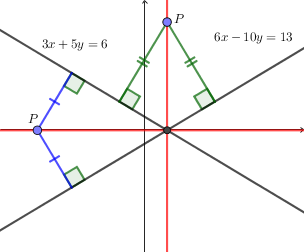
紅線是 P 點的軌跡,亦是兩線的角平分線 。
The red lines are the locus of Point P . They are also angle bisectors of the lines.
相關文章:常見軌跡 Common Loci
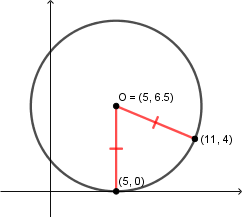
Let the y-coordinate of the centre be k.
圓心和圓周上任何點的距離均為相同。
The distances from centre to any points on the circumference are the same.
$$\begin{align*}
\sqrt{(5-5)^2 +(k-0)^2} &= \sqrt{(5-11)^2 +(k -4)^2}\\
0 + k^2 &= 36 + (k -4)^2\\
k^2 &= 36 +k^2 -8k +16\\
8k &= 52\\
k &= 6.5
\end{align*}$$ $$\begin{align*}
\text{半徑 radius} &= \sqrt{(5-5)^2 +(k-0)^2}\\
&= \sqrt{0 + (6.5)^2}\\
&= 6.5
\end{align*}$$ $$\begin{align*}
\text{圓周 Circumference} &=2\pi r\\
&=2 \times \pi \times 6.5\\
&= 13\pi
\end{align*}$$
P(2,6) &= \frac{2}{5} \times \frac{1}{4} \times 2 = \frac{1}{5}\\[2pt] P(3,6) &= \frac{1}{5} \times \frac{1}{4} \times 2 = \frac{1}{10}\\[2pt] P(4,6) &= \frac{1}{5} \times \frac{1}{4} \times 2 = \frac{1}{10}
\end{align*}$$ $$\begin{align*}
P(\gt 7) &= \frac{1}{5} +\frac{1}{10} +\frac{1}{10}\\[2pt] &= \frac{2}{5}
\end{align*}$$

四分位數間距 IQR ##=Q_3 -Q_1##,而平均數 Mean 無法從圖像獲得。
Without loss of generality, assume ##x \le y##.
先考慮分佈域為 9,由於 13 − 4 = 9,所以 x 和 y 不可大於 13。即是##x\le y\le 13##
Consider range is 9. Since 13 − 4 = 9, x and y cannot be greater than 13. i.e. ##x\le y\le 13##
已知平均數 Mean = 9,
\text{平均數 Mean} &= 9\\[2pt] \frac{4 +7 +7 +7 +8 +11 +11 +13 +x +y}{10} &=9\\[2pt] 68 +x +y &= 90\\
x +y &= 22
\end{align*}$$
結合以上兩個條件,x 和 y 的值只有三種可能組合。
Combining the three conditions above, there are only two possible combinations of values of x and y.
10 & 12 \\ 9 & 13
\end{array}$$
I)
方差 Variance = (標準差 Standard Deviation)²
當 ##x=11, y=11##,用計數機得到方差 Variance = 7。因此選項 I 並非必然正確。
II)
當 ##x=11, y=11##,
\text{中位數 Median} &= \frac{8+11}{2}\\[2pt] &=9.5
\end{align*}$$
當 ##x=10, y=12##,
\text{中位數 Median} &= \frac{8+10}{2}\\[2pt] &=9
\end{align*}$$
當 ##x=9, y=13##,
\text{中位數 Median} &= \frac{8+9}{2}\\[2pt] &=8.5
\end{align*}$$
所有情況下中位數都大於 7,因此選項 II 必然正確。
III)
當 ##x=11, y=11##,眾數 Mode = 11,因此選項 III 並非必然正確。
$$\begin{align*}
&\,1010100000001110_2\\
=&\,2^{15} +2^{13} +2^{11} +2^3 +2^2 +2^1\\
=&\,\color{red}{43022}
\end{align*}$$
然後計算各選項的數值
A) ##21 \times 2^{11} +14 = \color{red}{43022}##
B) ##21 \times 2^{11} +28 = 43036##
C) ##21 \times 2^{12} +14 = 86030##
D) ##21 \times 2^{12} +28 = 86044##
因此答案是 A。
方法二:
$$\begin{align*}
&\,1010100000001110_2\\
=&\,1010100000000000_2+1110_2\\
=&\,10101_2 \times 2^{11} + 1110_2\\
=&\,21 \times 2^{11} +14
\end{align*}$$
& x & y^3 & z^6 \\
& x & y^2 & z^4 \\
& x^d & y^e & z^f \\
\hline
\text{HCF}\ =\ & x & y^2 & z^\color{red}{3}\\
\text{LCM}\ =\ & x^\color{red}{2} & y^\color{red}{4} & z^6
\end{eqnarray}$$
比較各指數,可判斷 d、e、f 的值。
Comparing the indices, the values of d, e, f can be determined.
e = 4
f = 3
∴ 第三個數式是 ##x^2y^4z^3##。
相關文章:文憑試實戰篇 #17 代數式的 HCF 及 LCM
先用以上公式求取通項。
Find the general term with the formula.
$$\begin{align*}
T(n) &=S(n) -S(n -1)\\
&=(3^n -1) -(3^{n -1} -1)\\
&=3^n -3^{n-1}\\
&=3\times 3^{n-1} -3^{n-1}\\
&=3^{n -1}(3 -1)\\
&=2\times 3^{n -1}
\end{align*}$$
I)
$$\begin{align*}
T(n) &= 2\times 3^{n -1}\\
T(2) &= 2\times 3^{2 -1}\\
&= 2\times 3\\
&= 6
\end{align*}$$
因此選項 I 錯誤。
II)
##T(n)## 能以 ##ar^{n -1}## 形式表示,因此它是等比數列。
##T(n)## can be expressed in the form of ##ar^{n -1}##. Thus, it is a geometric sequence.
因此選項 II 正確。
III) 2 乘上任何正整數,結果都是偶數。
The product of 2 and any positive integer is even.
因此選項 III 正確。
##\begin{align*}
i^1 &= i\\
i^2 &= -1\\
i^3 &= -i\\
i^4 &=1
\end{align*}##
方法一:
$$\begin{align*}
&\,\frac{i^4 +2i^3 +3i^2 +4i}{\beta i -1}\\[2pt]
=&\,\frac{1 +2(-i) +3(-1) +4i}{\beta i -1}\\[2pt]
=&\,\frac{-2 +2i}{\beta i -1}\\[2pt]
=&\,\frac{(-2 +2i)\times (\beta i +1)}{(\beta i -1)\times (\beta i +1)}\\[2pt]
=&\,\frac{-2\beta i -2 +2\beta i^2 +2i}{\beta^2 i^2 -1^2}\\[2pt]
=&\,\frac{-2\beta i -2 -2\beta +2i}{-\beta^2 -1^2}\\[2pt]
=&\,\frac{-2 -2\beta -2\beta i +2i}{-\beta^2 -1^2}\\[2pt]
=&\,\frac{-2 -2\beta}{-\beta^2 -1^2}+\frac{-2\beta +2}{-\beta^2 -1^2}i\\[2pt]
\end{align*}$$
該數式是實數,亦即是虛部是 0
The expression is a real number. i.e. The imaginary part is 0.
$$\begin{align*}
\text{Imaginary part 虛部} &= 0\\
\frac{-2\beta +2}{-\beta^2 -1^2} &= 0\\
-2\beta +2 &= 0\\
-2\beta &= -2\\
\beta &=1
\end{align*}$$
方法二:借助計數機。
先計算 ##i^4 +2i^3 +3i^2 +4i##,得到 ##-2 +2i##
然後把各選項中的值代入 β,再用計數機計算其數值。
提示:##i^4## 可輸入 ##iiii## ,以避免計數機出現 Maths Error。
A) ##\Large\frac{-2 +2i}{-2i -1} \normalsize = -0.4 -1.2i##
只有選項 C 只到實數,因此答案是 C。
相關文章:文憑試實戰篇 #21 複數 Complex Numbers
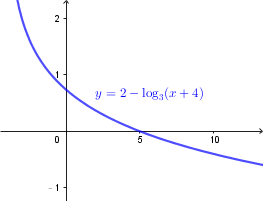
當 ##x=0, y=2 -\log_3(0 +4) = 0.738##
當 ##x=1, y=2 -\log_3(1 +4) = 0.535##
因此選項 I 錯誤。
II)
設 y = 0,
$$\begin{align*}
0 &= 2 -\log_3(x +4)\\
\log_3(x +4) &= 2\\
x +4 &= 3^2\\
x +4 &= 9\\
x & = 5
\end{align*}$$
因此選項 II 正確。
III)
設 x = 0,
$$\begin{align*}
y &= 2 -\log_3(0 +4)\\
&= 2 -\log_3 4\\
&= 0.738
\end{align*}$$
因此選項 III 錯誤。
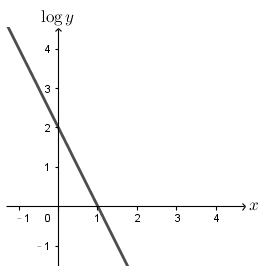
方法一:利用直線方程 Linear Equation
參考 y − y1 = m(x − x1)
\log y -2 &= \frac{2 -0}{0 -1}\big(x -0\big)\\[2pt] \log y -2 &= -2x\\
\log y &= 2 -2x\\
y &= 10^{2 -2x}\\
y &= 10^{2} \times 10^{-2x}\\
y &= 100 \times (10^{-2})^x\\
y &= 100 \times (0.01)^x
\end{align*}$$
∴ a = 100, b = 0.01
方法二:題目共給了兩個坐標,其意思如下:
x = 1\\
\log y = 0
\end{cases}\text{ and }
\begin{cases}
x = 0\\
\log y = 2
\end{cases}$$
從而得到
x = 1\\
y = 1
\end{cases}\text{ and }
\begin{cases}
x = 0\\
y = 10^2 = 100
\end{cases}$$
把 x =0, y = =100 代入 ##y = ab^x##
$$\begin{align*}
y &= ab^x\\
100 &= a\times b^0\\
a & =100
\end{align*}$$
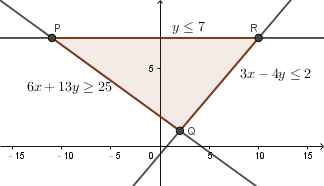
透過聯立方程(Simultaneous Equations),可找到 P, Q 及 R 點坐標。 P 點:
y =7\\
6x +13y=25
\end{cases}\\[4pt] P=(-11,7)
$$
3x -4y =2\\
6x +13y=25
\end{cases}\\[4pt] Q=(2,1)
$$
y =7\\
3x -4y =2\\
\end{cases}\\[4pt] R=(10,7)
$$
然後把各點坐標代入 5x + 4y +28。
P: 5(−11) +4(7) +28 = 1Q: 5(2) +4(1) +28 = 42
R: 5(10) +4(7) +28 = 106
因此 5x + 4y +28 的最小值是 1。
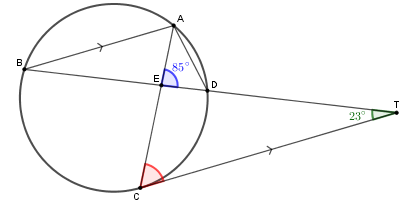
在 △CET,
\color{red}{\angle ECT} +\color{green}{\angle ETC} &= \color{blue}{\angle AED}\\
\angle ECT +\color{green}{23\deg} &= \color{blue}{85\deg}\\
\angle ECT &= 85\deg -23\deg\\
\angle ECT &= 62\deg
\end{align*}$$
步驟 2) 連接 BC,求 ∠ABC 及 ∠BAC
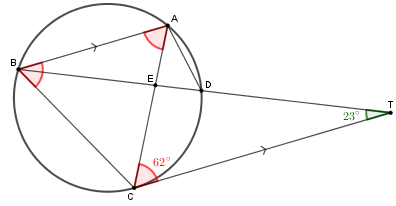
$$\because\ AB\,//\,CT\\
\therefore \angle BAC = \angle ACT = 62\deg\ \text{(錯角 alt. }\angle\text{, }AB\,//\,CT\text{)}$$ $$\begin{align*}
\angle ABC =& \angle ACT\ (\text{交錯弓形的圓周角}\ \angle\ in\ alt.\ segment\ )\\
\angle ABC =& 62\deg
\end{align*}$$
步驟 3) 連接 CD,求 ∠BDC
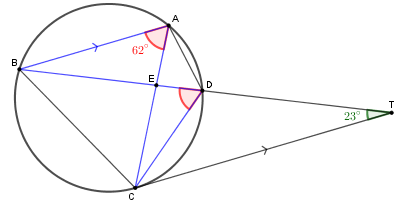
$$\begin{align*}
\angle BDC &= \angle BAC\ \text{(同弓形內的圓周角 }\angle s\ in\ the\ same\ segment\text{)}\\
\angle BDC &= 62\deg
\end{align*}$$
步驟 4) 求 ∠ADE
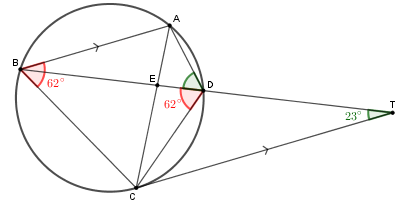
$$\begin{align*}
\angle ABC +\angle ADC &= 180\deg\ \text{(圓內接四邊形對角 }opp.\ \angle s,\,cyclic\ quad.\text{)}\\
62\deg +(\color{green}{\angle ADE} +62\deg) &= 180\deg\\
\color{green}{\angle ADE} &= 180\deg -62\deg -62\deg\\
\color{green}{\angle ADE}&=56\deg
\end{align*}$$
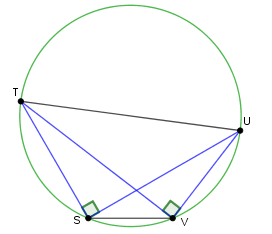
原因是 ∠TSU = ∠TVU,並運用同弓形內的圓周角的逆定理 (Converse of ∠s in the same segment)
步驟 1) 求 ∠USV
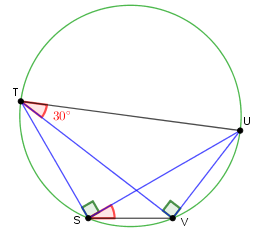
$$\begin{align*}
\angle USV &= \angle UTV\ \text{(同弓形內的圓周角 }\angle s\ in\ the\ same\ segment\text{)}\\
\angle USV &= 30\deg
\end{align*}$$
步驟 2) 求 TV 及 ∠STV
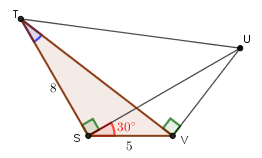
$$\begin{align*}
TV^2 &= 5^2 +8^2 -2(5)(8)\cos(90\deg +30\deg)\\
TV &= \sqrt{129}
\end{align*}$$ $$\begin{align*}
\frac{\sin \angle STV}{5} &= \frac{\sin(90\deg +30\deg)}{\sqrt{129}}\\[2pt]
\sin \angle STV &= \frac{5\sin 120\deg}{\sqrt{129}}\\
\angle STV &= 22.4\deg
\end{align*}$$
步驟 3) 求 ∠SUV
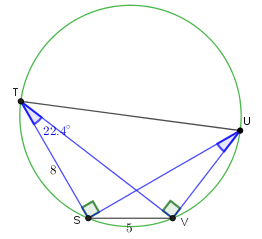
$$\begin{align*}
\angle SUV &= \angle STV\ \text{(同弓形內的圓周角 }\angle s\ in\ the\ same\ segment\text{)}\\
\angle SUV &= 22.4\deg\\
\angle SUV &\approx 22\deg
\end{align*}$$
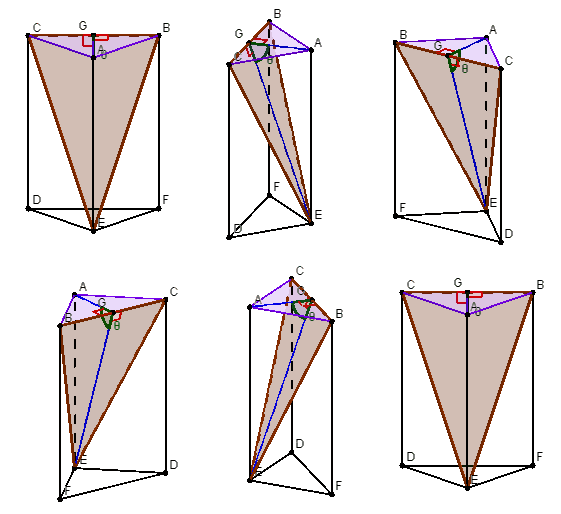
步驟 1) 求 AG
設 AB = AC = 1, AE = 2
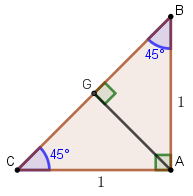
留意 △ABC 是等腰直角三角形 (right-angled isosceles triangle),
因此 ∠ACB = 45°。
在 △ACG,
\sin 45\deg &= \frac{AG}{AC}\\[2pt] \frac{1}{\sqrt{2}} &=\frac{AG}{1}\\[2pt] AG &= \frac{1}{\sqrt{2}}
\end{align*}$$
步驟 2) 求 EG 及 sin θ
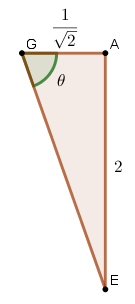
$$\begin{align*}
EG^2 &= AG^2 + AE^2\\[2pt]
EG^2 &= \Big(\frac{1}{\sqrt{2}}\Big)^2 + 2^2\\[2pt]
EG^2 &= \frac{1}{2} +4\\[2pt]
EG^2 &= \frac{9}{2}\\[2pt]
EG &= \frac{3}{\sqrt{2}}
\end{align*}$$ $$\begin{align*}
\sin \theta &= \frac{AE}{EG}\\[2pt]
&= \frac{2}{\frac{3}{\sqrt{2}}}\\[2pt]
&= \frac{2\sqrt{2}}{3}
\end{align*}$$
$$\begin{align*}
6\sin^4 \theta -5\sin^2 \theta +1 &= 0\\
6u^2 -5u +1 &= 0\\
u = \frac{1}{2}\ \text{ or }\ u &= \frac{1}{3}\\[2pt] \sin^2 \theta = \frac{1}{2}\ \text{ or }\ \sin^2 \theta &= \frac{1}{3}
\end{align*}$$
情況 1) ##\sin^2\theta = \frac{1}{2}##
$$\begin{align*}
\sin^2 \theta &= \frac{1}{2}\\[2pt]
\sin \theta &= \frac{1}{\sqrt{2}}\text{ or }\sin \theta = \frac{-1}{\sqrt{2}}\\[2pt]
\theta &= 45\deg\ \text{(捨去 rej.)}, 135\deg, 225\deg, 325\deg
\end{align*}$$
情況 2) ##\sin^2\theta = \frac{1}{3}##
$$\begin{align*}
\sin^2 \theta &= \frac{1}{3}\\[2pt]
\sin \theta &= \frac{1}{\sqrt{3}}\text{ or }\sin \theta = \frac{-1}{\sqrt{3}}\\[2pt]
\theta &= 35.3\deg\ \text{(捨去 rej.)}, 144.7\deg, 215.3\deg, 324.7\deg
\end{align*}$$
∴ 共有 6 個根。
&\,P(\text{最多2名男生})\\[2pt] =&\,1 -P(\text{3名男生})\\[2pt] =&\,1 -\frac{C_3^3 \times C_2^7}{C_5^{10}}\\[2pt] =&\,1 -\frac{1 \times 21}{252}\\[2pt] =&\,\frac{11}{12}
\end{align*}$$
1) 5名全職 + 2名兼職
2) 4名全職 + 3名兼職
情況 1)
先從所有雇員選出 5 名全職及 2 名兼職。
First, choose 5 full-time employees and 2 part-time employees from all employees.
$$\begin{align*}
&\,\text{組合數目 Number of Combinations}\\
=&\, C_5^5 \times C_2^3\\
=&\, 1 * 3\\
=&\, 3
\end{align*}$$
然後再安排他們列隊,先把 5 名全職雇員排成一列,並有 5! 種排列方法。』
Then, arrange the 5 employees to form a queue. There are 5! ways to arrange the queue.
以 F 代表全職雇員。橫線代表可容納一人的位置。共有 6 個位置可容納兼職雇員。
Letter F represents a full-time employee. An underscore represents an empty place for a single part-time employee. There are 6 possible places for the part-time employees.
把餘下 2 名兼職雇員安排這6個位置中,共有 ##P_2^6## 種排列方法。
Arrange the remaining 2 part-time employees to these 6 empty places. There are ##P_2^6## ways to arrange the part-time employees.
$$\begin{align*}
&\,\text{列隊的排列方式總數}\\
&\,\text{Total number of ways to arrange a queue}\\
=&\,(C_5^5 \times C_2^3) \times 5! \times P_2^6\\
=&\,10800
\end{align*}$$
情況 2)用同一方法處理。
$$\begin{align*}
&\,\text{列隊的排列方式總數}\\
&\,\text{Total number of ways to arrange a queue}\\
=&\,(C_4^5 \times C_3^3) \times 4! \times P_3^5\\
=&\,7200
\end{align*}$$
把兩個情況的結果加起來。
$$\begin{align*}
&\,10800 +7200\\
=&\,18000
\end{align*}$$
$$\text{standard score 標準分 }z=\frac{x -\mu}{\sigma}$$##x## = raw value 原始值
##\mu## = mean 平均值
##\sigma## = standard deviation 標準差
$$z=\frac{x -\mu}{\sigma}$$##z## = standard score 標準分
##x## = raw value 原始值
##\mu## = mean 平均值
##\sigma## = standard deviation 標準差
$$\begin{cases}
0 = \frac{40 -\mu}{\sigma}\ …(1)\\[2pt]
2 = \frac{58 -\mu}{\sigma}\ …(2)
\end{cases}$$
從 (1),
$$\begin{align*}
0 &= 40 -\mu\\
\mu &= 40
\end{align*}$$
把 μ = 40 代入 2。
$$\begin{align*}
2 &= \frac{58 -40}{\sigma}\\[2pt]
2\sigma &= 18\\[2pt]
\sigma &= 9
\end{align*}$$
方法一:
計算 β 及 α 的值。
$$\begin{align*}
3 &= \frac{\beta -40}{9}\\[2pt]
\beta &= 40 +3 \times 9\\
&= 67\\[8pt]
-1 &= \frac{\alpha -40}{9}\\[2pt]
\alpha &= 40 -9\\
&= 31
\end{align*}$$ $$\begin{align*}
\beta -\alpha &= 67 -31\\
&= 36
\end{align*}$$
方法二:
$$\begin{align*}
\beta &= \mu +3\sigma\\
\alpha &= \mu -\sigma
\end{align*}$$ $$\begin{align*}
\beta -\alpha &= (\mu +3\sigma) -(\mu -\sigma)\\
&= 4\sigma\\
&= 4 \times 9\\
&= 36
\end{align*}$$
方差 Variance = (標準差 Standard Deviation)²
在每個數據乘上相同的常數 k。
Standard Deviation 標準差為原來的 k倍。在每個數據加上相同的常數標準差並無改變。
Standard deviation does not change.
$$\because \frac{p +2}{5} = \frac{p}{5} +\frac{2}{5}$$ ∴ 新的標準差 new standard deviation ##= \frac{5}{5} = 1##
$$\begin{align*}
\text{方差 Variance} &= 1^2\\
&= 1
\end{align*}$$
分類: 計數機應用及歷屆試題


發表回應